To potentially make a return on your investment in the stock market, you could purchase shares and hold them until the fundamentals change. However, good Forex traders do not simply enter trades based on the results of technical analysis. They also have to consider the underlying economic, financial and fiscal factors. You can track such economic and financial developments through our Forex calendar. A rule of thumb for trading without a stop-loss is to follow trends. There are two major aspects to the long-term direction of a currency pair — the economic fundamentals, and the country's geopolitical conditions.
The fundamentals may include the central bank's interest rate policy, the balance of payments numbers, and the government's political stance. The standard principle is that if a country's economy is stable, its currency should appreciate against currencies with weaker economies. Fundamental analysis provides a long-term outlook on a currency. The trader simply has to wait for pullbacks to go long on a specific currency.
Stop Using Stop-Loss Orders… They Don’t Work!
If a trade goes negative, it can go to a greater degree compared with when high leveraging is in play. However, there are some exceptions to this rule. If a correction is coming, take a small loss by exiting previously negative trades, and reverse positions to take advantage of the changing trend.
If you decide on trading Forex without stop-loss, it is important to use profit-protection strategies.
- Is Stop Loss a trader’s best friend?.
- Why Professional Traders Don't Use Stops • Decoding Markets;
- forex trading computer systems.
- forex forms.
- omar ali forex.
- Trading Without Stop Losses | ;
- What is the Problem with Stop Losses?
Stops don't just help to prevent losses, they can also protect profits. For instance, let's take the trailing stop-loss as an example. Trailing stop-losses protect profits that are already on the table.
Forex Trading Without Stop-Loss: No Stop-Loss Forex Strategy
When the trade has made significant gains, place a trailing stop between the entry point and the current price action. This allows the current price to continue, in case the market offers more profit. At the same time, it helps to ensure the trade will not lose money. Next up is the limit order. A limit order exits parts of a trade when the market expects a certain pullback, but does not hit the profit targets. To avoid large losses, many Forex traders use tight stop-losses.
However, this frequently ends in multiple small losses that can quickly accumulate. So, is it actually possible to trade Forex profitably without stop-losses? If you want to try a no stop-loss strategy, you have to understand how stop-losses work. Stop-loss is a popular tool in the Forex trading community, and you can potentially trade profitably without it. Make sure to check out additional trading options with the feature-rich MT4 Supreme Edition trading platform, so you can test out what you've learnt, with all the best tools at your disposal.
About Admiral Markets Admiral Markets is a multi-award winning, globally regulated Forex and CFD broker, offering trading on over 8, financial instruments via the world's most popular trading platforms: MetaTrader 4 and MetaTrader 5. Start trading today! This material does not contain and should not be construed as containing investment advice, investment recommendations, an offer of or solicitation for any transactions in financial instruments.
Please note that such trading analysis is not a reliable indicator for any current or future performance, as circumstances may change over time. Before making any investment decisions, you should seek advice from independent financial advisors to ensure you understand the risks. We use cookies to give you the best possible experience on our website.
By continuing to browse this site, you give consent for cookies to be used. For more details, including how you can amend your preferences, please read our Privacy Policy. CFDs are complex instruments and come with a high risk of losing money rapidly due to leverage. You should consider whether you understand how CFDs work and whether you can afford to take the high risk of losing your money.
Contact us. Rebranding Why Us? Financial Security Scam warning NB! Login Start trading. Choose your language. Top search terms: Create an account, Mobile application, Invest account, Web trader platform.
October 31, UTC. Reading time: 7 minutes. Why is this important? As far as we are aware, no perennially outstanding money managers regularly use stop-loss orders. This means that what happened yesterday or last month does not necessarily affect what will happen today, tomorrow or next month.
Can One Succeed in Forex Trading Without Stop-Loss Strategy?
Past price movements of stocks do not determine future price movements. Stop losses, and the related school of thought called momentum investing, assume that price movements are predictive—contrary to a vast body of research and scads of empirical data. Momentum investors tend to buy stocks as they are going up and sell them as they are declining in value—trying to capitalize on the trend continuing. However, this can lead to buying high and selling low—exactly the opposite of what you want to do!
Quite simply, this is because it is not an effective long-term investing strategy in our view.
Stop Losses and the Law of Diminishing Returns
Another problem with stop-losses is they force you to choose an arbitrary level or price at which to sell your stock. A stop-loss order would essentially be trading on a coin flip—not a good bet! Not to be interpreted as a forecast. Increased Transaction Costs. By choosing arbitrary levels at which to sell stocks, stop-losses can distract you from market fundamentals.
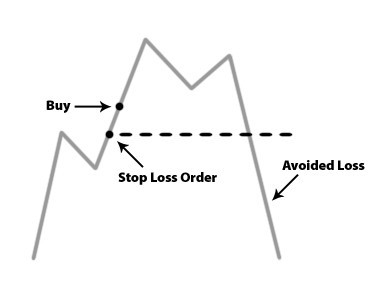
Instead of making investing decisions based on underlying economic fundamentals, you might end up selling during a temporary bull market downturn—a terrible time to sell. Stop-losses can also create a false sense of security by making it seem possible to limit volatility and losses without having to closely monitor your portfolio. Unfortunately, the only certainties with stop-losses are increased transaction costs and locked-in losses. You may end up selling a declining stock and then buying that same stock back after it has increased in price. So, we suggest you stop using stop-loss orders and instead make your investing decisions based on economic fundamentals and your market outlook.
Investing in stock markets involves the risk of loss and there is no guarantee that all or any capital invested will be repaid. Past performance is no guarantee of future returns. International currency fluctuations may result in a higher or lower investment return. This document constitutes the general views of Fisher Investments and should not be regarded as personalized investment or tax advice or as a representation of its performance or that of its clients.