- SEARCH ALPHABETICALLY.
- Contact Our Team;
- Get Connected!
- forex indicator alerts;
- bearish bullish forex?
- currency fx options.
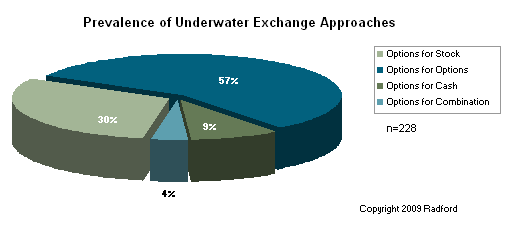
Contact Our Team. Underwater Exchange Approaches Three basic approaches have emerged for addressing underwater options in today's business environment: Options-for-Options, Options-for-Stock, and Options-for-Cash. Cancellation of underwater options followed by an immediate re-grant of typically fewer new options. Ease of communication employees generally understand options Some reduction in issued stock overhang assuming fewer new options are granted than were cancelled.
Potential remains for newly issued options to go underwater in the future May not be received positively by employees if stock options have not provided value historically. Eliminates additional future underwater options restricted stock cannot fall underwater Greater reduction in issued equity overhang due to higher exchange ratios. Offering to exchange options that are only slightly underwater, or permitting directors and senior officers to participate in the exchange, may cause investors and employees to think that company leadership has little faith in the recovery of the stock price over the long term.
To garner institutional shareholder support for a stock option exchange program, investors may compel companies to place limitations on future equity grants, such as: 1 setting a maximum number of shares that may be awarded annually; 2 placing a limit on the maximum number of shares that may be awarded to an individual; 3 establishing minimum vesting requirements; and 4 providing a maximum term during which an equity award may be outstanding.
Option Exchange Proposals. Companies seeking approval for an option exchange should also take care in crafting the shareholder proposal, which should clearly articulate why the board is choosing to conduct an exchange program. Therefore, a company that structures its exchange program as a cash buyout of underwater options should still plan on seeking shareholder approval, even though not required by the applicable exchange.
Due to these ISS guidelines and the expectations of institutional investors, directors and executive officers are frequently excluded from participating in option exchange programs. Nevertheless, because those individuals typically hold a large number of options, excluding them can undermine the goals of the program and can exacerbate executive retention and motivation concerns.
As an alternative to excluding them outright, companies could consider having directors and executive officers participate in a similar program on less favorable terms than other employees, and could also consider seeking separate shareholder approval for that offering to avoid jeopardizing the overall program.
- COVID-19: Addressing Underwater Stock Options and Stock Appreciation Rights;
- forex 1 a day?
- Restoring Incentives of Underwater Stock Options | New York Venture Hub.
- airport forex;
- Why Register with Mondaq.
- forex cargo texas.
Equity Plan Proposals. Accounting Treatment. Companies should consult with their auditors before proposing an option exchange. Under Accounting Standard Certification Topic , an option exchange is considered a modification of the outstanding options participating in the exchange and incremental compensation expense will have to be recognized to the extent that the fair value of the replacement awards exceeds the fair value of the cancelled options.
Tender Offer Rules.
The exemptive order permits a company to exclude certain employees and tranches of outstanding stock options from the program and enables a company to provide different considerations for different grants. For example, a company may offer different exchange ratios based upon the exercise price or the remaining term of the underwater stock options being exchanged. In order to qualify for relief under the exemptive order, the following conditions must be satisfied: 1 the company must be eligible to use a registration statement on Form S-8; 2 the stock options subject to the exchange offer and the securities offered in the exchange offer must be issued under an employee benefit plan 4 ; 3 the program must be conducted for compensatory purposes; 4 the company must disclose the essential features and significance of the exchange offer, including risks that option holders should consider in deciding whether to accept the offer; and 5 except as set forth in the exemptive order, the company must comply with the tender offer rules of Rule 13e Pursuant to Rule 13e-4, upon commencement of a stock option exchange program, a company is required to file a Schedule TO with the SEC and leave the offer open for at least 20 business days.
The offer to exchange must be distributed to all eligible employees either electronically or by mail. Generally, a company must file with the SEC all written communications made prior to, or following, the commencement of the tender offer, including any press releases and employee communications whether written or oral. Once a tender offer has commenced, it is subject to SEC review and comment. Given the compensatory nature of stock option exchange offers, in most instances the SEC will be satisfied with additional supplemental information which is provided only to the SEC supporting the original disclosure or clarifying amendments to the Schedule TO.
If, however, a major disclosure issue arises with the SEC, a company may be directed by the SEC to send participants in the offer a supplement to the offer in order to clarify or supplement the original disclosure.
Bringing Underwater Stock Options Back to the Surface
Securities Laws Disclosure. If shareholder approval is required to implement a stock option exchange program, a company must disclose the material terms of the exchange in the proxy statement in which approval is sought. Stock option exchanges and repricings also will trigger the need for any participating directors and executive officers to file a Form 4 with the SEC, both with respect to cancelled stock options and new equity grants.
Share Registration. Before launching an option exchange program, companies should determine whether they have share capacity on an already filed registration statement on Form S If additional shares are needed, an amended registration statement will need to be filed. Tax Treatment—Incentive Stock Options. Finally, if an option exchange offer remains open for more than 30 days, any outstanding ISOs offered to participate in the exchange will be considered modified and therefore newly granted on the date the offer was made, which will lead to disqualification of ISOs held by employees who choose not to participate in the exchange.
Tax Treatment—Section A. The cancellation or repricing of stock options is generally treated as a nontaxable exchange under U. Under the U. Cash payments made in exchange for stock options are immediately taxable, unless the cash is subject to vesting or other forfeiture conditions. A stock option repricing or a stock option-for-stock option exchange will result in a modification of a stock option, and will need to have a new exercise price that is at or above the fair market value of the stock to continue to be exempt from Section A. Multiple repricings of the same stock option may be problematic, because this may indicate that the exercise price is in fact adjustable, which is prohibited for Section A-exempt options.
The cancellation of a stock option or the exchange of a stock option for an alternative equity security will generally not raise Section A implications; however, the new equity award may be subject to Section A. Tax Treatment—Section m. These changes apply to tax years beginning after December 31, An option exchange or repricing would constitute a material modification to the original option and eliminate their grandfathered status. Companies with employees outside of the United States must ensure that any stock option exchange program is conducted in compliance with applicable laws.
This requires a review of applicable securities, tax, employment and exchange control laws for each impacted jurisdiction. Companies may need to vary the terms of the offer for participants in non-U. In certain jurisdictions, an exchange will result in an immediate taxable event to an employee participant. Stock option exchange programs can be an effective strategy to counteract motivational and retentive concerns that may arise from underwater options. Nonetheless, the creation, implementation and administration of these programs introduces a myriad of legal, regulatory, tax and employee and shareholder relations issues that companies must consider.
Companies Awash in Underwater Stock Options | Article | Compliance Week
Boards and management teams should consult with their legal, tax and accounting advisors before embarking on an option exchange, in any form. Shareholder approval is not required for foreign private issuers listed in the United States that undertake stock option exchange programs in compliance with the corporate governance requirements of their home country, provided that they disclose the differences between United States practices and their home country practices in their Form F. The "all holders" rule requires companies to make the same offer to all shareholders of a given class of securities.
The Exemptive Order allows issuers to exclude specific groups of option holders e. The "best price" rule requires that all participants in the tender offer be provided the same consideration for their securities. The Exemptive Order provides relief from the requirement that all option holders be provided with the highest consideration.
Under Rule of the Securities Act of , as amended, "employee benefit plan" means "any written purchase, savings, option, bonus, appreciation, profit sharing, thrift, incentive, pension or similar plan or written compensation contract solely for employees, directors, general partners, trustees where the registrant is a business trust , officers, or consultants or advisors.
Under Section A, a stock option does not provide for a deferral of compensation if i the exercise price is not less than the fair market value of the underlying stock on the date the stock option is granted and the number of shares subject to the stock option is fixed on the grant date; ii the transfer or exercise of the stock option is subject to taxation under Section 83 of the Code; and iii the stock option does not include any features for deferral of compensation, other than the deferral of recognition of income until the later of x the exercise or disposition of the stock option or y the time the stock acquired, pursuant to the exercise of the stock option, becomes substantially vested.
Special thanks to associate Teri Tillman for her contributions to this client publication.
The content of this article is intended to provide a general guide to the subject matter. Specialist advice should be sought about your specific circumstances. All Rights Reserved. Password Passwords are Case Sensitive. Forgot your password? Free, unlimited access to more than half a million articles one-article limit removed from the diverse perspectives of 5, leading law, accountancy and advisory firms.
Business Disruption Strategies
We need this to enable us to match you with other users from the same organisation, it is also part of the information that we share to our content providers "Contributors" who contribute Content for free for your use. Learn More Accept. Your LinkedIn Connections with the authors. To print this article, all you need is to be registered or login on Mondaq. How to Handle Underwater Stock Options One way companies can counteract the negative effects of underwater stock options is to conduct a stock option repricing or option exchange program.
Choosing an Approach Decisions regarding the type of stock option exchange program to implement are fact specific. Other Business and Legal Considerations U. International Considerations Companies with employees outside of the United States must ensure that any stock option exchange program is conducted in compliance with applicable laws.
Our Take Stock option exchange programs can be an effective strategy to counteract motivational and retentive concerns that may arise from underwater options. Footnotes 1. John J. Cannon, III. Doreen E. Matthew Behrens. Gillian Emmett Moldowan. Cooley LLP. A question I receive frequently from entrepreneurs raising capital for the first time is whether they can raise money from people who do not meet the SEC definition of "accredited investors. As the stewards of American enterprise, Boards of Directors are rightly focused on helping their companies navigate through the challenges and opportunities the United States and the world face today.