The organization takes overproduction of raw material, backward intermediary or key process forward to realize cost advantage. Reduces flexibility. Extensive barriers that may limit to one industry are created. Cement, steel and textile companies are vertically diversified.
- Maintenance page;
- Ways to Create Value.
- Diversification: Definition, Levels, Strategy, Risks, Examples.
In India, cement manufacturers have captive power generation plants. Concentric diversification. The market is regarded as a domain of related but heterogeneous needs that an organization can meet with heterogeneous but allied offerings.
Diversification via Acquisition: Creating Value
There is s difference between the products and technology but a broad marketing scope enables to leverage of brand value. Conglomerate diversification. Diversification in totally unrelated areas. New areas may present better growth options, entry barriers may be low as must be the investment required.
Organizations can diversify globally also. Two different situations from the contemporary business world are presented for your analysis and discussions. Present your analysis as a report covering some aspects of SWOT you may refer to official websites , and review of options in the light of course material. Be specific in your recommendation.
Most of these options are similar in the sense they are based on the principle of creating collaboration for the growth of two different entities. The differences among them are more of a degree than direction. The subtle differences between joint venture alliances and between mergers and takeovers are more for conferring the legal status on the entity as well as the transfer of funds and resources.
A company needs to choose a path or approach to diversify its business. It may choose either related diversification approach or unrelated diversification approach or a combination of both, depending on circumstances. The principal difference between the two is that related diversification emphasizes some commonality in markets, products, and technology, whereas unrelated diversification is based mainly on profit considerations. The strategists must consider the realities of the situations for selecting the right approach for diversification.
- Diversification: Definition, Levels, Strategy, Risks, Examples;
- an introduction to stock and options pdf?
- online forex broker reviews.
Your company is pursuing a strategy of related diversification if you find that multiple lines of businesses are finked with your company. The new business is operated in the same industry. Both the new business and the core business have some commonalities in their value chain activities such as production, marketing, etc. The value chains of both businesses possess strategic ms.
Because of the existence of commonality in value chains in both the existing and new businesses, business-to-business transfer of key skills, technological expertise or managerial know-how is possible. Companies usually implement related diversification strategies to build a competitive advantage and achieve economies of scope. An analysis of the practices of various diversified companies reveals that they seek related diversification in either of the two ways or a combination of the two.
These ways are a related- constrained, and b related-linked. When the business-units of a company share the inputs, production technologies, distribution channels, etc.
Unrelated Diversification And Shareholders Value
For example, BIC is said to follow a related- constrained diversification, as all of its products razors, cigarette lighters, and pens share significant commonalities in the areas of plastic injection molding, brand name, and retail distribution. On the other hand, in the case of related-linked diversification, the business-units are linked on a few dimensions.
The products are sold under various brand names, and they do not share common technology or inputs across segments. For example, Walt Disney was a related-constrained firm until the early s. But it moved to related-linked firms gradually when it started making movies for mature audiences and acquired ABC television. Many companies prefer a related diversification strategy to an unrelated diversification strategy.
Along the value chain, cross-business strategic fit can exist in, for example! If two or more businesses under the parent company can share the same distribution facilities e. Businesses with closely related sales and marketing activities can perform better together because of reduced sales costs reason: sharing of the same sales force. Strategic fits in supply chain activities help in skills transfer in procuring materials in achieving stronger bargaining power in negotiation with suppliers, etc.
It has strategic appeal because it allows a company to build a stronger competitive advantage through skill transfer, lower costs, common brand name and better competitive capabilities. Related diversification has the potential of achieving economies of scope. It may be noted that economies of scale are achieved when the unit cost of products are reduced as the volume of production increases. It provides a sharper focus for managing diversification because of concentration in similar businesses.
It can result in greater consolidated performance than a single-business concentration strategy. A stand-alone enterprise cannot perform better than a company having related businesses.
Diversification strategy
It can create value through resource sharing between various businesses. It involves fewer risks because the company moves into business areas about which top management already has some knowledge. Situations Favorable for Related Diversification Research evidence suggests that related diversification does not always yield more benefits than unrelated diversification.
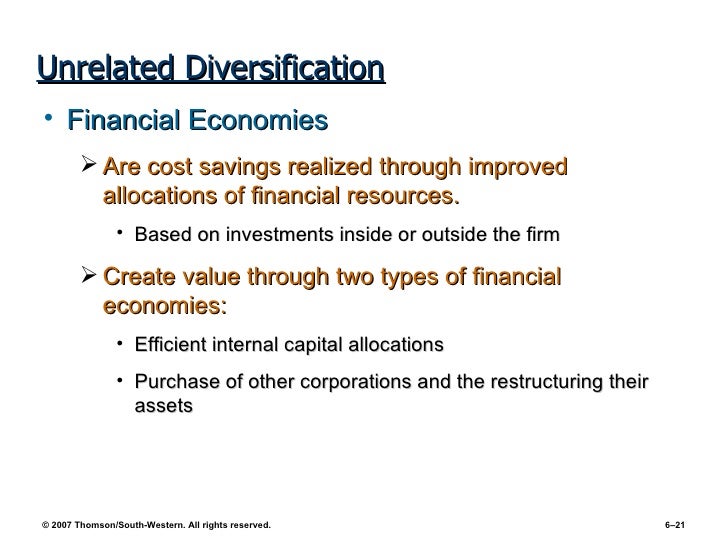
Unrelated diversification involves entering into new businesses that are not related to the core business of the company. An unrelated diversified company has more than one businesses which are operating their activities in different industries. As a result, the diversified company has little opportunity to transfer skills, technology or other resources from one business to another. Each business-unit in the unrelated diversified company is a stand-alone entity. Each SBU remains responsible for profit-making.
For example, Company A started initially with the business of producing a marker pen. Both efforts were disasters. Although Harley-Davidson and Starbucks both enjoy iconic brands, these strategic resources simply did not transfer effectively to the bottled water and furniture businesses. Skip to content Firms using diversification strategies enter entirely new industries. Three Tests for Diversification A proposed diversification move should pass these three tests or it should be rejected.
Unless the industry has strong profit potential, entering it may be very risky. Cost-of-Entry Test — How much will it cost to enter the industry? Executives need to be sure that their firm can recoup the expenses that it absorbs in order to diversify. Better Off Test — Will the new unit and the firm be better off? Unless one side or the other gains a competitive advantage, diversification should be avoided. Related Diversification Because it leverages strategic fit, companies that engage in related diversification are more likely to achieve gains in shareholder value.
Example 7. Porter, M. From competitive advantage to corporate strategy. Harvard Business Review, 65 3 , — The core competencies of the corporation. A strong management team at the acquired company ensures realization of the potential benefits of diversification. Many companies try to limit their pool of acquisition candidates to well-managed companies.
This policy is rarely the necessary condition for gaining the potential benefits of diversification. Usually such improvement requires an exchange of core skills and resources among the partners. The benefits of unrelated diversification are rooted in two conditions: 1 increased efficiency in cash management and in allocation of investment capital and 2 the capability to call on profitable, low-growth businesses to provide the cash flow for high-growth businesses that require significant infusions of cash. Indeed, if the acquired company is well managed and priced accordingly by the capital market, the acquirer must exploit the potential synergies with the acquiree to make the transaction economically justifiable.
The diversified company is uniquely qualified to improve the performance of acquired businesses. Consider the testimony of Harold S. We can improve operating efficiencies and profits sufficiently to make this valuation worthwhile to both sets of shareholders.
Diversification Strategies
To gain the benefits Geneen claimed, a company needs only to allow managers with the requisite skills to implement their desired improvements in the organization. Rarely, it may be argued, does an organization willingly take steps that could alter its traditional administrative and managerial practices.
Under these circumstances, change will occur only when forced from the outside, and diversifying companies often represent such a force. Nevertheless, the benefits achieved are not, strictly speaking, benefits of diversification. This role involves developing diversification objectives and acquisition guidelines that fit a carefully prepared concept of the corporation. A company following a diversification strategy can create value for its shareholders only when the combination of the skills and resources of the two businesses satisfies at least one of the following conditions:.
This comparison deserves comment. Most benefits derived from reducing unsystematic corporate risk through diversification are, of course, equally available to the individual investor. Diversified companies can achieve trade-offs between total risk and return that are superior to the trade-offs available to single-business companies. Diversified companies cannot create value for their stockholders merely by diversifying away unsystematic risk.
Inasmuch as investors can diversify away unsystematic risk themselves, in efficient capital markets unsystematic risk is irrelevant in the equity valuation process. A diversifying company can create value for its shareholders only when its risk-return trade-offs include benefits unavailable through simple portfolio diversification. There are seven principal ways in which acquisition-minded companies can obtain returns greater than those obtainable from simple portfolio diversification. The first four are particularly relevant to related diversification, while the last three are more relevant to unrelated diversification.
When the reinforcement of skills and resources critical to the success of a business within the combined company leads to higher profitability, value is created for its shareholders. This reinforcement is the realization of synergy.