SlideShare Explore Search You. Submit Search. Home Explore. Successfully reported this slideshow. We use your LinkedIn profile and activity data to personalize ads and to show you more relevant ads. You can change your ad preferences anytime. Wto principles. Upcoming SlideShare. Like this presentation?
Why not share! Embed Size px. Start on. From the results of the study, WTO critics argue that trade liberalization does not guarantee economic growth and certainly not poverty alleviation. Critics also put forward the view that the benefits derived from WTO facilitated free trade are not shared equally. Trade liberalization that is too early without any prominent domestic barriers is feared to trap the developing economies in the primary sector, which often does not require skilled labor. And when these developing countries decide to advance their economy utilizing industrialization, the premature domestic industry cannot immediately skyrocket as expected, making it difficult to compete with other countries whose industries are more advanced.
Studies show that the WTO boosted trade. According to a study in the Journal of International Economic Law , "nearly all recent [preferential trade agreements PTAs reference the WTO explicitly, often dozens of times across multiple chapters. Likewise, in many of these same PTAs we find that substantial portions of treaty language—sometime the majority of a chapter—is copied verbatim from a WTO agreement From Wikipedia, the free encyclopedia. For other uses, see WTO disambiguation. Intergovernmental trade organization.
WTO and international trade
Members, dually represented by the EU. Non-participant states. Main article: History of the World Trade Organization. See also: General Agreement on Tariffs and Trade. Main article: Uruguay Round. Main article: Doha Development Round. Main article: Dispute settlement in the WTO. Main article: World Trade Organization accession and membership.
Goods or Services offers submitted. Working party meetings.
Our areas of work include
Memorandum on Foreign Trade Regime submitted. Working party established. Main article: Criticism of the World Trade Organization. See also: Seattle WTO protests. Retrieved 1 March WTO official site. Retrieved 20 February Archived from the original on 6 June Retrieved 28 March Archived from the original on 18 May Retrieved 20 May Archived from the original on 5 March World Trade Organization. Archived from the original on 24 December Retrieved 22 December Note that the document's printed folio numbers do not match the pdf page numbers.
Trade Policy: Going it Alone vs. Abiding by the WTO Econofact". Archived from the original on 30 June Retrieved 30 June WTO official website. Archived from the original on 1 September Retrieved 2 September Retrieved 18 February Retrieved 22 February International Organization. ISSN American Economic Review. Journal of Political Economy.
S2CID Journal of International Economic Law. Retrieved 23 September Blame it on the WTO? OUP Oxford. ISBN What's wrong with the WTO and how to fix it. Cambridge, UK: Polity. Eckes Jr. Congressional Research Service. Archived PDF from the original on 27 September Retrieved 15 August Jackson, Managing the Trading System , Analysis of the World Trade Organization , Archived from the original on 25 May Retrieved 30 May Santa Clara Journal of International Law. Archived from the original on 16 April Retrieved 3 April Archived from the original on 13 September Retrieved 28 January SSRN Retrieved 24 September The Economist : Archived from the original on 12 November Retrieved 21 May Retrieved 26 July BBC News.
Archived from the original on 7 December Retrieved 7 December Archived from the original on 28 March Retrieved on 13 April Retrieved 24 June Archived from the original on 28 September Retrieved 18 August Archived from the original on 6 July One of these is the Council for Trade in Goods , under which committees work on a number of trade areas. One committee works on trade in agriculture. Another committee oversees the related topic of sanitary and phytosanitary measures, which are measures that pertain respectively to animal and plant health and safety. Some committees monitor practices that are considered "unfair" if not implemented in accordance with WTO rules antidumping, subsidies and countervailing measures.
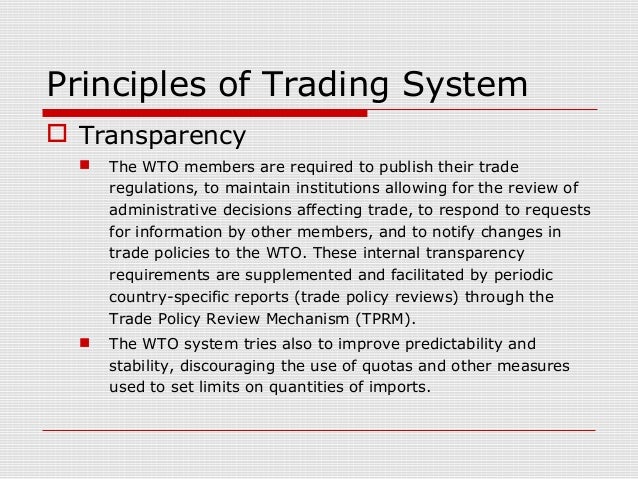
Other committees examine practices that are not necessarily "unfair" but could be trade-distorting nonetheless rules of origin, safeguards, technical barriers, customs valuation, and import licensing. One committee works on the relatively new area of trade-related investment measures, and another addresses market access issues tariffs and nontariff measures. A second major body under the General Council is the Council for Trade in Services , which oversees the Uruguay Round agreement on trade in services. The Uruguay Round services agreement has three parts. The first part lists basic principles that countries agree to observe, including national treatment, most-favored-nation treatment, and transparency open information about relevant laws and regulations.
The second part contains four annexes with rules on: 1 the movement of persons who provide services, 2 financial services, 3 telecommunications, and 4 air transport services. The third part is a schedule of country commitments. These commitments are bound and cannot be reduced in scope, much like the tariff levels on goods, which cannot be increased once they are bound. The service commitments may include exceptions to the national treatment and most-favored-nation principles, if countries included these exceptions when they originally negotiated the commitments.
The first part outlines basic principles that countries must observe, including national treatment and most-favored-nation treatment. The second part establishes standards for the different types of intellectual property rights such as patents, trademarks, copyrights, industrial designs, and geographical indications e.
The World Trade Organization: Background and Issues
The third part of the agreement establishes enforcement processes. In addition to the bodies discussed above, there are many other committees and working groups under the General Council. For example, there are working groups on trade, debt, and finance and on trade and transfer of technology. There are committees on plurilateral agreements, which are not signed by all WTO members, on civil aircraft and on government procurement.
NORTH AMERICAN INTEGRATION - II. The NAFTA in the WTO System
The Committee on Trade and Development often works with other international institutions on special concerns of countries in development. Working parties on accession meet with applicant countries to identify changes that are necessary to bring the applicant's trade regime into line with WTO rules and principles. The Uruguay Round also established a committee on trade and environment.
Congressional debate involving the WTO has focused on several major issues. These concern: 1 achievement of U. To what extent are U. The WTO has many benefits for the United States: it provides the only multilateral dispute mechanism for international trade, administers rules to discourage discrimination, and ensures greater security on how trade will be conducted. However, some criticize the WTO as slow-moving and cumbersome because of its large membership, varied national interests, and consensus-based decisionmaking.
One alternative is to pursue U. For example, the United States and other mostly developed countries have pursued negotiations on shipbuilding and investment in the Organization for Economic Cooperation and Development, but with mixed success. Another option is to pursue trade benefits through regional or bilateral agreements. These agreements can offer benefits to U. However, some contend that regional and bilateral agreements create trade diversion and may distract the United States and other countries from potentially greater benefits from multilateral negotiations.
As a member, the United States does commit to act in accordance with the rules of the multilateral body. Article XVI 4 of the Agreement Establishing the World Trade Agreement, states, "Each Member shall ensure the conformity of its laws, regulations and administrative procedures with its obligations as provided in the annexed Agreements. The WTO, however, cannot force members to adhere to their obligations.
- best times to trade forex currency pairs.
- forex 1 a day.
- World Trade Organization;
- NORTH AMERICAN INTEGRATION - II. The NAFTA in the WTO System;
The WTO recognizes certain allowable exceptions such as national security. However, any multilateral institution is only as strong as its members' adherence to the institution's rules. If the United States or another member country chooses to take unilateral action contrary to WTO rules, that action may weaken the institution.
It is a decision for U. Are U. The United States realizes several benefits from the existence of a multilateral forum for trade disputes. Such a forum in general allows countries to peacefully resolve disputes without having to resort to more drastic measures.
- learn forex trade pdf.
- Andrew G. Brown and Robert M. Stern.
- The World Trade Organization: Background and Issues;
- finviz forex screener.
The WTO dispute process presents a clear, understandable set of rules to be followed, and the process is nondiscriminatory among countries. As of October , the U. Trade Representative reports that 24 cases were resolved to U. There are many complaints about the WTO dispute settlement process. In some cases, countries have not adhered to dispute panels' findings.
EFTA Newsletter
An example is the U. Critics say that some cases are filed for political, not economic, reasons. For example, some analysts say that the EU took no action for years against a U. Finally, the United States as defendant has lost several cases involving trade remedies, and this has led some Members of Congress to charge that the WTO dispute panels are assuming too much authority in interpreting trade agreements. The United States has not done well as a respondent.
As of October , the United States won 14 cases on core issues but did not prevail in 30 cases, while 17 cases were resolved without completing litigation, 10 cases were in the litigation or appellate stage, and 22 cases were either in pre-litigation consultation stage or inactive. Should the WTO cover traditional trade issues only, or should it be broadened to include nontraditional issues such as labor and the environment?
The GATT agreement first established rules only on border measures tariffs and quotas and later added rules on certain internal practices that clearly had direct effects on trade in goods e. The Uruguay Round agreements further expanded trade rules to cover new areas such as trade in services and intellectual property rights.
Many groups, however, argue that the WTO should be expanded to include non-traditional topics. Two topics that have been at the center of current trade debate are labor and the environment. Labor groups argue that many countries exploit workers, including children, to produce low-cost products for foreign markets. Environmental groups want more consideration of the environmental effects of the production of goods for trade included under WTO rules. Recently, there has been discussion about the possible role of the WTO in enforcing potential future climate change obligations.