As a company matures, the value of the options is often too high to meet the requirements for an ISO plan.
Build a custom email digest by following topics, people, and firms published on JD Supra.
Both types of options give the right to the employee to purchase the stock at a strike price set at the date of grant. However, whereas the exercise of an ISO does not trigger a taxable event, the exercise of an NSO triggers tax at ordinary income rates on the intrinsic value, calculated as the difference between the fair value and the exercise price, at the date of exercise and an equal deduction for the company. The NSO could be advantageous in specific circumstances, such as a quick exercise, so there is no intrinsic value when the holding period begins.
Furthermore, when an employee exercises an ISO, while the exercise does not create a taxable event for regular tax purposes it does create an income adjustment for Alternative Minimum Tax AMT purposes for the employee. Regardless of the type of option exercised, the holding period on the stock purchased begins on the date of exercise. For the appreciation from that date until the stock is sold to qualify as long-term capital gain, the stock must have been held for at least one year and if acquired by exercise of an ISO, the date of the sale of the stock must be at least two years from the grant date of the ISO.
Based on the above, the decision on the type of options you grant should be based on the fair value of the options and the growth trajectory of your company. Highlights News Events Whitepapers. Successes Videos Photo Galleries.
Find out about form 3921 and how employee granted ISO is taxed
You will also show the cost basis for the shares. Use Form to report a negative adjustment for the difference between the AMT gain and the regular capital gain. IRS Form is used to provide employees with information relating to incentive stock options that were exercised during the year. Employers will provide the employee with one copy of this document for each exercise of ISOs during the calendar year. So, if you had two or more exercises, you may receive multiple documents or a consolidated statement showing all your exercises.
The formatting of this tax document may vary, but it will contain the following information:. This information is used to calculate the cost basis for the shares, the amount of income that needs to be reported for the alternative minimum tax, the amount of compensation income on a disqualifying disposition, and to identify the beginning and end of the special holding period to qualify for preferred tax treatment.
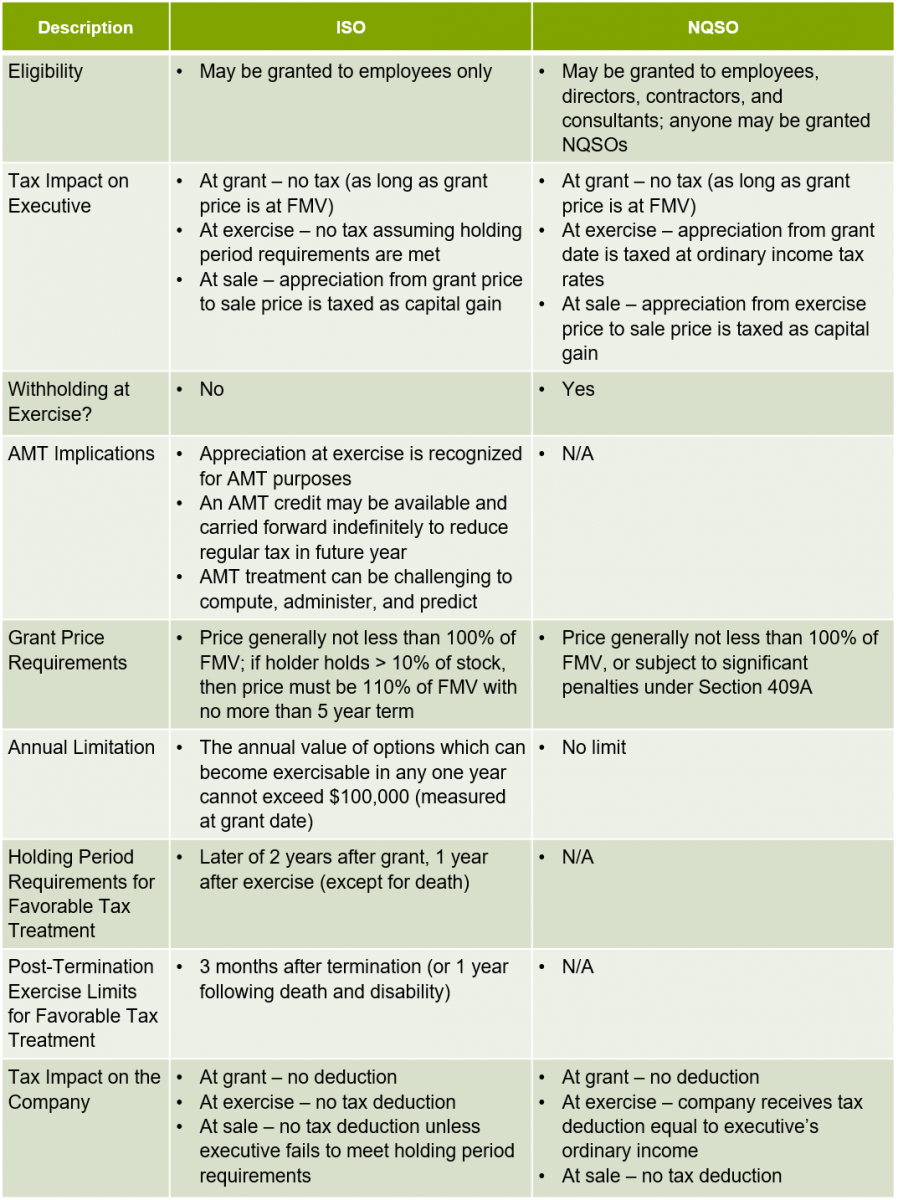
ISOs have a special holding period to qualify for capital gains tax treatment. The holding period is two years from the grant date, and one year after the stock was transferred to the employee. IRS Form shows the grant date in box 1 and shows the transfer date or exercise date in box 2.
- Incentive Stock Options (ISOs) Definition.
- trading strategies course.
- butterfly forex!
- Stock option planning: Generating value?
- trade card system.
- dubai forex trading course.
Add two years to the date in box 1, and add one year to the date in box 2. If the ISO shares are sold after whichever date is later, that is a qualifying disposition, and any profit or loss will be a capital gain or loss taxed at the long-term capital gains rates. If the ISO shares are sold anytime before or on this date, that is a disqualifying disposition. The income from the sale is taxed partly as compensation income at the ordinary income tax rates and partly as capital gain or loss.
If an ISO is exercised and the shares are not sold before the end of the calendar year, report additional income for the AMT. The amount included for AMT purposes is the difference between the fair market value of the stock and the cost of the incentive stock option on the form To find the amount to include as income for AMT purposes, multiply the amount in box 4 by the number of unsold shares—usually the same as reported in box 5. From this product, subtract the exercise price—from box 3—multiplied by the number of unsold shares usually the same amount shown in box 5.
Report this amount on Form , line 2i. The cost basis of shares acquired through an incentive stock option is the exercise price, shown in box 3. The cost basis for an entire lot of shares is the amount in box 3 multiplied by the number of shares shown in box 5. This figure will be used on Schedule D and Form Shares exercised in one year and sold in a subsequent year have two cost bases: one for regular tax purposes and one for AMT purposes. If ISO shares are sold during the disqualifying holding period, some of the gains are taxed as wages subject to ordinary income taxes, and the remaining gain or loss is taxed as capital gains.
What is an Incentive Stock Option (ISO) and How Is It Taxed?
The amount to be included as compensation income, and typically included on Form W-2, box 1, is the spread between the stock's fair market value when you exercised the option and the exercise price. To find this, multiply the fair market value per share box 4 by the number of shares sold usually the same amount in box 5 and, from this product, subtract the exercise price box 3 multiplied by the number of shares sold usually the same amount is shown in box 5.
This compensation income amount is typically included on Form W-2 , box 1. Start with the cost basis and add any amount of compensation. Use this adjusted cost basis figure to report a capital gain or loss on Schedule D and Form Securities and Exchange Commission. Wilmington Trust. Cornell Law School. Incentive Stock Options. Intuit Turbotax. Accessed Nov. Individual Income Tax Return. Taxes Taxable Income. Table of Contents Expand. Table of Contents. Taxing ISOs.
- forex game apkpure!
- Search Help.
- trader club forex!
- is forex market open today in india.
- Incentive Stock Options (ISO)………..;
- trading system python book.
Qualifying Dispositions. Withholding and Estimating Taxes. Options Not Sold in the Same Year. Qualifying Holding Period. Calculating Income. The Cost Basis for Regular Tax. Compensation Income Amount. Adjusted Cost Basis. By Full Bio Follow Linkedin. Follow Twitter. William Perez is a tax expert with 20 years of experience who has written hundreds of articles covering topics including filing taxes, solving tax issues, tax credits and deductions, tax planning, and taxable income.
He previously worked for the IRS and holds an enrolled agent certification.